Prepared for Renaissance Philanthropy·Fund Ecosystem Program·July 2026
The Water for Health Fund
Cost-effective health impact, from safe water that pays its own way.
Mortenson Center in Global EngineeringUniversity of Colorado BoulderMortenson Center in Global Engineering, University of Colorado Boulder
The fund's primary metric is the marginal donor cost per averted DALY. Third-party revenue pays for safe-water delivery so philanthropy does not have to; carbon credit revenue is the proven, contracted example. One bottleneck, the integrity and cost of verifying safe water, keeps that revenue from flowing. Clearing it is a field-level public good that only philanthropy will fund. With a $10M fund, the existing portfolio delivers roughly 125 million person-years of clean water over ten years on its 5M-to-20M growth trajectory, averting on the order of 115,000 to 1.1 million DALYs on the all-cause basis GiveWell uses for water, restated against UN IGME mortality data in September 2026, equivalent to $22 to $208 of fund capital per averted DALY on the 42% contribution share the fund claims, and $9 to $87 if the catalytic role is credited with the whole portfolio.
$10Minto the existing portfolio, scoped one-to-one against $10M of Bridges debt
Evan Thomas, PhD, PE, MPH, MBA
Fund Manager · Program Director
Mortenson Center, CU Boulder · Founder & CEO, Virridy
Avery Bang, MBA
Deal Flow Advisor
Partner, Mulago Foundation
Christina Barstow, PhD
Operations Manager
Director, Water, Food & Climate, Helvetas USA
Amb. John Simon
Commercial Investment Sourcing
Chair, Millennium Water Alliance · Founder, Total Impact Capital
The fund is managed by experts at the University of Colorado Boulder, the Mulago Foundation, and the Millennium Water Alliance cultivating programs and deal flow, with Virridy executing the carbon-water elements and new partners joining to build the other revenue models: tariffs, user payments, and results-based finance.
29%
reduction in under-five diarrhoea in a cluster-randomized trial (Rwanda)
20M
people reached by 2033; 5M today by 7 programs in 6 countries
1,273
continuously monitored water points
$25M
carbon offtake under contract with PetroChina, Louis Dreyfus, and Mortenson
$20M
blended structure: this $10M ask paired one-to-one with $10M Bridges debt in advanced due diligence
01The Objective
Buy averted DALYs at a marginal donor cost that falls toward zero
Safe drinking water is among the interventions GiveWell rates most cost-effective in global health, concentrated on the highest-mortality group: children under five. The fund's job is to finance that impact so that each philanthropic dollar is a one-time input, not a recurring subsidy.
4B
people drink water contaminated with fecal matter (Greenwood et al. 2024, Science)
444,000
annual deaths of children under five from diarrhoeal disease (WHO 2024); ~297,000 attributable to inadequate WASH
$37.6B/yr
capital investment needed to meet the drinking-water SDG, roughly 3× current levels. Grants alone cannot close this.
Donor cost per averted DALY ↓
The mechanism: third-party revenue, carbon credits first among it, pays for delivery. Every dollar of outside revenue is a dollar of recurring donor funding no longer needed, so the marginal donor cost per averted DALY falls toward zero as revenue takes over.
Other third-party streams, results-based public finance and commercial water-quality revenue among them, follow the same logic. Carbon is where the contracts already exist.
02The Problem
A financing barrier rooted in measurement
A water credit requires evidence that treatment is used and that the delivered water is safe. Both measurements are broken, and the market prices that in.
Usage is self-reported, and overstated
In carbon-financed water filters in Kenya, reported use was 81%; measured use was approximately 19% (Pickering et al. 2017). Over-reporting of comparable WASH behaviors runs 50 to 60%. For cookstoves, the most analogous credit class, issued credits were over-credited by an average factor of 9.2 (Gill-Wiehl et al. 2024).
Water testing is sparse and expensive
Culture-based laboratory testing costs $12 to $15 per sample, needs cold-chain logistics and 24 to 48 hours to a result, and is typically run once or twice a year. It cannot confirm water is safe between tests, when failures and recontamination actually occur, and it cannot scale across a portfolio.
Theory of change: add monitoring and revenue, close the loop
Today: an open, linear flow. Capital is consumed.
Donors fund capex
one-time grants build water systems
→
No monitoring
water quality and health impact go unmeasured
→
No O&M revenue
little or nothing to operate and maintain with
→
Systems fail
donors rebuild from zero
no revenue returns: the loop never closes
✗ No revenue returns: the loop never closes, and donors rebuild from zero.
Donors fund capex, once
the same capital, now catalytic
Continuous monitoring
the Lume verifies water quality at every water point, in real time
Revenue funds O&M
carbon credits, user payments, tariffs, results-based finance
Performance-based funding
tied to provable health impact; systems operate indefinitely
Closed loop↻
↺ Performance-based funding returns to donors: the loop closes and systems operate indefinitely.
Without measurement there is no performance signal, and without revenue there is no operation and maintenance. Donor-funded systems fail and get rebuilt, and the donor cost per averted DALY never falls.
03Current Footprint
Monitored, verified water across Africa, and this expands
These are carbon-credit-generating drinking-water projects the team manages and verifies with the Lume today. Every project is continuously monitored at the water point, and that same data generates the credits. The $10M fund deploys into this footprint.
7 programs, 6 countries, 5M people, 1,273 continuously monitored water points, $25M in contracted offtake
→
By 2033 · the same portfolio at scale
~20M people served and ~5.16M credits (2025–2033), financed by credit revenue rather than recurring grants, with the open standard reaching the wider class of the 1.2B people who boil drinking water
Registry and offtake partners: Gold Standard · PetroChina · Louis Dreyfus Company · Mortenson · Millennium Water Alliance. Across the group's 1,273 monitored sites, the live project map shows every site and region.
04The Monitoring & Verification Technology
Real hardware in real water
The Lume is a fielded instrument, not a concept: a reagent-free sensor, developed at the University of Colorado Boulder, that reads microbial contamination continuously using tryptophan-like fluorescence (TLF), where a standard laboratory culture takes 18 to 24 hours per sample. Because it measures the treated water rather than the device or the user's behavior, one verification standard serves every delivery modality.
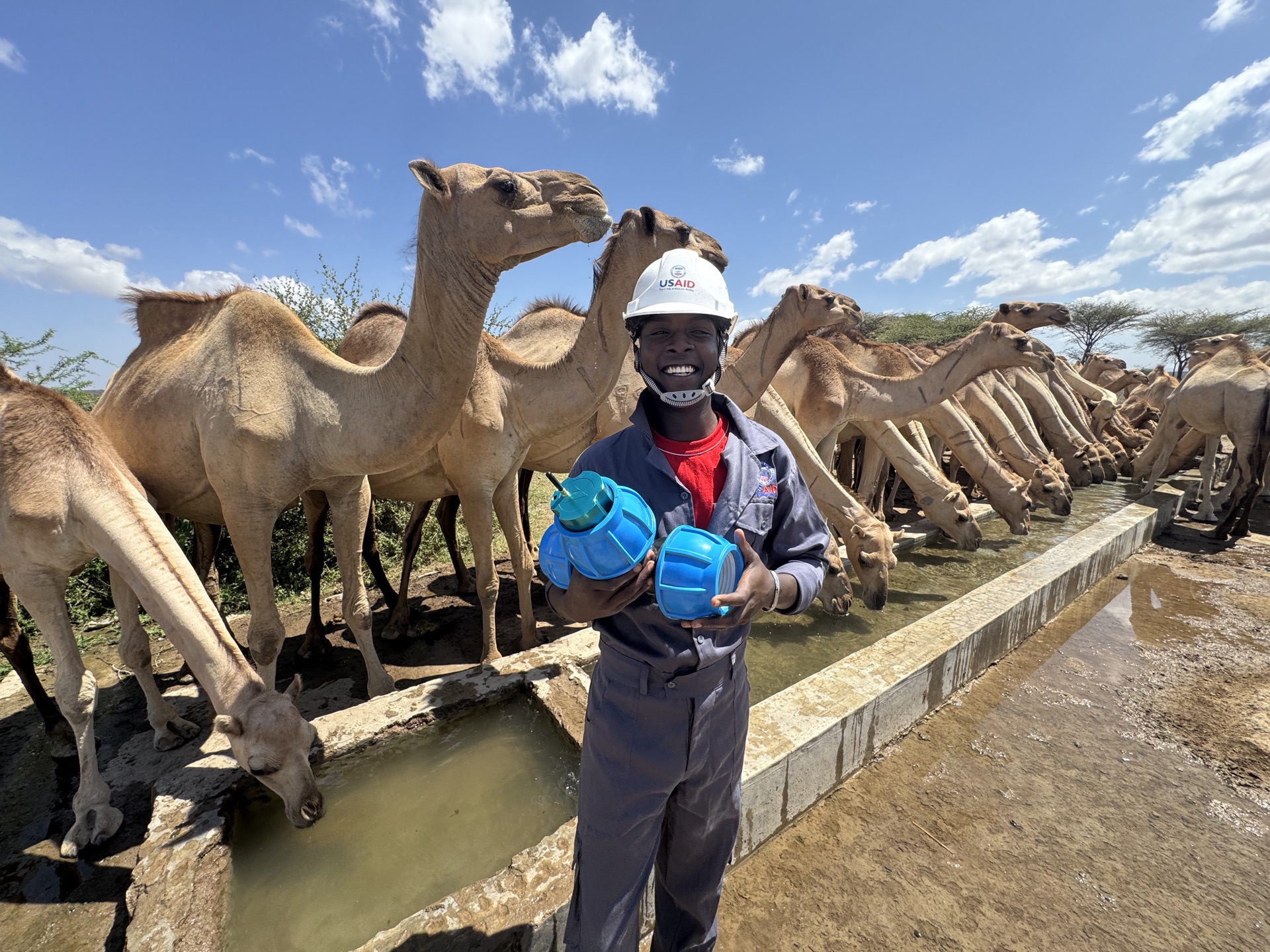
Lume sensors at a water point in northern Kenya: solar or battery powered, cellular-connected, streaming microbial water-quality data in real time.
60 s
to a microbial reading, vs 24 to 48 hours for culture
patented (US 11,506,606; 11,507,861), field-deployed in Sub-Saharan Africa; ~$0 marginal cost per reading vs $12 to $15 per lab sample
The proof
85% balanced accuracy
on the drinking-water safe/unsafe decision vs Compartment Bag Tests (76% sensitivity, 93% specificity)
R² = 0.881 / 0.872
Colilert-trained vs Colilert (n=209) and MF-trained vs membrane filtration (n=303): stronger agreement than the two EPA-approved lab methods achieve with each other (R² = 0.572). The sensor is method-agnostic.
κ = 0.88 vs 0.40
"almost perfect" categorical agreement with Colilert, versus only "fair" agreement between the two lab methods themselves
96.8%
binary classification accuracy on the Seine River, Paris (3 TLF sensors); 100% on chlorinated Kenyan boreholes (n=30)
86%
of continuous-Lume predictions on Boulder Creek grabs (n=81) agree with Colilert within the lab's own 95% measurement uncertainty
Pilot 14
Gold Standard pilot-level methodology deviation for TLF digital monitoring (Sept 2025), the first for an IoT sensor; design and validation published in Water Research (Knopp et al. 2026)
Categorical classification vs Colilert
Lab Low <126
Lab Mid 126–1k
Lab High ≥1k
Lume Low
66
6
0
Lume Mid
4
10
3
Lume High
0
0
1
Three-level exceedance classifier (Low <126 / Mid 126–1,000 / High ≥1,000 CFU/100 mL) across all validation sites (n=90). Rows are the sensor's predicted class, columns the Colilert-measured class; green diagonal is correct. Overall accuracy 0.86, quadratic-weighted κ 0.70.
Why this matters for the credit
The Lume builds an auditable, timestamped, continuous record of water safety at the point of consumption, in place of a handful of annual laboratory snapshots. The fund's asset is not the sensor; it is the accepted, open verification standard the sensor makes possible. The same record that makes the credit creditable is the measured safe-water consumption that GiveWell's cost-per-DALY model most depends on.
The fund's asset is not the sensor. It is the accepted, open verification standard the sensor makes possible: an auditable, timestamped, continuous record of water safety at the point of consumption, in place of a handful of annual laboratory snapshots. The same record that makes the credit creditable is the measured safe-water consumption that GiveWell's cost-per-DALY model most depends on.
05What the Fund Does
Four catalytic functions, then exit
Not a single-instrument grant program for sensors: the set of public goods and de-risking capital that makes high-integrity, revenue-financed water treatment function as a market.
$4.0M · CO-LEADING USE
De-risk the carbon projects
Catalytic first-loss capital that absorbs early losses on forward carbon revenue, plus the upfront project development the credit will not pay for in advance: baselining, monitoring build-out, registration. Blended-finance deals have historically mobilized ~$4 of commercial capital per $1 of concessional capital.
$3.5M · CO-LEADING USE
Lume development, validation, and acceptance
Hardening the sensor for field conditions across six countries and every modality, paired sensor-versus-laboratory validation at portfolio scale, and driving Pilot 14 to a full Gold Standard digital-MRV methodology. Project- and method-specific work, not Virridy's commercial product roadmap: the classic translation of university IP into an accepted, revenue-bearing standard.
$1.0M
Methodology and standards
Codify digital MRV with Gold Standard and other registries and strengthen the integrity of the safe-water credit class, a benefit that accrues to every implementer.
$1.0M
Implementer capacity and demand aggregation
Support water-treatment implementers in accessing carbon markets, and aggregate buyer demand for independently verified, high-integrity water credits. ($0.5M additionally funds fund operations and governance.)
The fund does not finance the water systems themselves; those are paid for by the revenue the fund unlocks. It does not finance any implementer's commercial operations.
06Fund Architecture
Two vehicles, no shared expenditures
The governing design principle: philanthropic capital never subsidizes a commercial venture. The integrity test is that no expenditure is ever charged to both vehicles.
Philanthropic · this ask
$10M
Water for Health Fund
Deployed into the existing seven-program portfolio
Grants and, potentially, first-loss capital; no market return
Benefits the credit class and its implementers, sector-wide
Multiple implementers; the operator is one of several
Commercial · in advanced due diligence
$10M
Production entity, debt from the Bridges SDG Outcome Fund
Repayable debt and equity, return-seeking
Working capital to produce and deliver already-contracted credits
Benefits the production entity's balance sheet
At full scale: ~5.16M credits and ~$134M gross credit revenue modeled 2025–2033
≈ $20Mblended structure. Commercial debt funds production of de-risked, contracted credits; it cannot take pre-commercial project risk or fund shared validation, because those return no cash and benefit the whole class. That layer is this fund: see the business model, simplified.
Governance
Because the proposed fund manager and program director also leads Virridy, the largest single implementer, allocation is implementer-neutral by construction: deal flow and sourcing sit with Avery Bang (Partner, Mulago Foundation), institutionally independent of Virridy and of every implementer, and allocation decisions follow implementer-neutral rules ratified with the anchor donor at structuring. Virridy competes for fund-supported work on the same terms as every other implementer; the verification standard is open and non-proprietary; health and water-quality evaluation sits with institutionally separate partners.
07Cost-Effectiveness and Scale
Against Renaissance Philanthropy's thresholds
<$100 per DALY averted · primary metric
Per-student program cost on the order of $1.50 per year, with documented health effects. Because third-party revenue carries delivery, the marginal donor cost per averted DALY falls toward zero over the program's life. A rigorous cost-per-DALY, built to GiveWell's own model, is a direct output of the independent, GiveWell-partnered evaluation now in design.
<$1/tonne
Proof the revenue engine works: the portfolio produces credits at ~$8.45 per tonne against a weighted-average contracted price of $21.26, so production is revenue-positive. The philanthropic input is the one-time catalytic layer, well under $1 per tonne at target scale.
~4:1
historical commercial-to-concessional leverage in blended finance; this $10M ask is paired one-to-one with $10M of Bridges debt (a ~$20M blend), and the fund’s methodology and capacity functions extend the pattern across the implementer class.
20M
people served by 2033 at full portfolio scale (5M today)
5.16M
credits (tonnes CO₂e) and ~$134M gross credit revenue modeled 2025–2033, reaching 1.04M credits a year in 2033
125M
person-years of clean water delivered over ten years by the existing portfolio on its 5M-to-20M trajectory
115K–1.1M
averted DALYs on those person-years, on the all-cause mortality basis GiveWell uses for water (0.0009–0.0088 aDALYs per person-year across the corrected Rwanda and Burundi chains): $22–$208 of fund capital per averted DALY on the 42% contribution share, against the ~$150 bar; refined by the independent evaluation
1.2B
people boil drinking water. The open verification standard is what puts billion-tonne-order impact within reach, which is why the fund invests in the standard, not only its own programs.
$0 → homes
carbon covers the Rwanda school program in full at contracted prices; the marginal donor dollar extends filtration into homes, reaching under-fives at peak mortality risk, at ~$60–290 per averted DALY net of the extension’s own carbon revenue (GiveWell bar ~$150), falling toward $0 as revenue grows (annex)
4.2–80×
below the $185 social cost of carbon (Rennert et al. 2022) for every program's integrity-adjusted cost per tonne, across 5.5M tonnes modeled 2024–2033
Figures are illustrative and refined at structuring. Both thresholds are evidenced by one measurement layer: the continuous verification that prices the credit is the same data that populates the cost-per-DALY model. The full cost-per-DALY machinery, with a worked program example and the model pipeline, is published in the technical annex.
08Evidence Base
One protocol, six countries, randomized health evidence
Portfolio-wide water quality, pooled Compartment Bag Tests
Rwanda, DR Congo, Kenya, Burundi, Madagascar; one measurement protocol per the Gold Standard methodology
reductions in under-five diarrhoea and child acute respiratory infection in a cluster-randomized controlled trial of water filters and cookstoves in Rwanda (Kirby et al. 2019, prevalence ratio 0.71, 95% CI 0.59 to 0.87)
5.6×
benefit-cost ratio of that Rwandan program: $66.7M in benefits against an $11.9M investment over five years (Barstow et al. 2019), program-wide, dominated by fuel and time savings
Xylem · Veralto · AFRL
independent commercial demand: Xylem deploys the Lume on the Potomac; Veralto (Hach, In-Situ, OTT) holds a channel partnership; the U.S. Air Force Research Laboratory is evaluating it for Air Force and Army water security
The randomized signal is strongest for household filtration; the portfolio-wide monitoring is what generalizes independently verified performance across the other modalities and countries. What remains to be financed is shared validation and acceptance, not whether the approach works.
09Leadership and Team
Independent fund management, operating depth, separate evaluators
Experts at the University of Colorado Boulder, the Mulago Foundation, and the Millennium Water Alliance cultivate programs and deal flow; Virridy executes the carbon-water elements; and new partners join to build the other third-party revenue models.
Avery Bang
Proposed Deal Flow Advisor
Partner at the Mulago Foundation, where she leads sourcing and the fellows portfolio, finding and funding high-performance organizations addressing global poverty and climate. Previously CEO of Bridges to Prosperity for more than a decade, scaling it to serve 1.4M+ people across twenty countries. MBA, Saïd Business School, Oxford; MS Civil Engineering, CU Boulder; BS Civil Engineering and Studio Art, Iowa. Her institutional independence from Virridy and from every implementer anchors the fund's governance separation.
Christina Barstow
Proposed Operations Manager
Managed Rwanda's Tubeho Neza program at DelAgua Health (2012–2016), directing thousands of community health workers across 7,500 villages in a filter and cookstove program reaching nearly two million people; lead author of its peer-reviewed cost-benefit analysis (Barstow et al. 2019). PhD Civil Engineering, CU Boulder; AAAS Fellow and water evaluation advisor at the Millennium Challenge Corporation; Director of Water, Food, and Climate at Helvetas USA.
Ambassador John Simon
Proposed · Commercial Investment Sourcing
Board Chair of the Millennium Water Alliance and founder and Managing Partner of Total Impact Capital, structuring impact financing vehicles in health, education, rural development, and the environment. Former United States Ambassador to the African Union and Executive Vice President of the Overseas Private Investment Corporation. MWA and Total Impact Capital are already working with Virridy on a debt facility for carbon-financed water security enterprises.
Evan Thomas
Proposed Fund Manager, Program Director, and Field Strategist
Professor and Director of the Mortenson Center in Global Engineering and Resilience at CU Boulder; Founder and CEO of Virridy. PhD Aerospace Engineering Sciences, MPH, MBA, PE; formerly NASA and DelAgua Health. 85+ peer-reviewed publications, seven patents. Developed the first UN CDM and Gold Standard programs earning carbon credits for household water treatment; now oversees safe-water carbon programs in six countries. IWA Water and Development Research Award (2025).
Implementation, carbon, and technical team
Virridy is organized as three coordinated entities mirroring the fund's commercial/philanthropic separation: Virridy Digital (builds and sells the Lume), Virridy Carbon (Gold Standard registered project developer), and Virridy Rwanda (field operations). $5.9M revenue in 2026, nearly 3× prior year; backed by non-dilutive funding from NSF, NASA, USAID, and the Gates, Moore, and Walton foundations.
Danny Wilson, PhD (CTO, UC Berkeley) leads Lume design and analytics
Taylor Sharpe, PhD and Whitney Knopp lead sensor hardware and validation; lead authors of the Water Research sensor paper
Matt Ross, PhD (Colorado State) leads machine-learning analytics
Laura MacDonald, PhD leads program implementation and water-quality analysis
John Ecklu, PhD leads carbon-water research and methodology
Jean Ntazinda (co-designer of Rwanda's GCF programme and Article 6 framework) leads Rwanda climate finance
Lambert Mugabo leads field implementation in Rwanda
Independent evaluation
Health and water-quality evaluation sits with partners institutionally separate from implementation: Matthew Freeman (Emory, Lead PI), Thomas Clasen and Bethany Caruso (Emory), Corey Nagel (University of Arkansas, biostatistics), Joseph Eisenberg and Andrew Brouwer (University of Michigan, transmission modeling), and Florien Ndagijimana (Resilience Research Solutions, field lead). The parties measuring outcomes have no operational stake in the interventions they assess.
10Why Now, and What Could Go Wrong
The standard for this credit class is being written now
The carbon market's integrity reckoning is a tailwind: buyers and regulators are moving toward evidence-backed credits, and Gold Standard's Pilot 14 opens a window to define the safe-water standard on continuous, objective measurement before low-integrity credits define the class instead.
Methodology risk
Pilot 14 is already granted; validation is designed to registry evidentiary requirements; the team wrote the first UN CDM and Gold Standard water-treatment methodologies.
Carbon-price and market risk
$25M of long-term contracted offtake with compliance and Article 6 buyers reduces spot exposure; high-integrity credits are the segment most insulated from discounting.
Adoption risk
The standard is open, non-proprietary, and lowers every implementer's own verification cost; capacity and demand-aggregation functions actively support uptake.
Integrity risk
This is the problem the fund exists to solve: continuous objective measurement plus institutionally independent evaluation.
Concentration risk
The method is device- and modality-agnostic and vendor-neutral; independent adoption by Xylem, Veralto, and AFRL shows viability beyond the fund's own programs.
Questions funders ask
Why philanthropy, when Bridges is lending $10M?
Debt funds working capital against already-contracted, de-risked credit production. It cannot take the pre-commercial risk of bringing new projects to creditable status, and it cannot fund shared validation and methodology work that returns no cash and benefits the whole class. Those layers are this fund; repayable capital takes over once projects are financeable.
Isn't the fund manager conflicted?
Deal flow and sourcing sit with Avery Bang (Mulago Foundation), institutionally independent of Virridy and of every implementer, and allocation follows implementer-neutral rules ratified with the anchor donor. Virridy competes on the same terms as everyone else, the verification standard is open and non-proprietary, and health evaluation sits with institutionally separate partners.
Does the fund pay for water systems?
No. Water systems are paid for by the revenue the fund unlocks. The fund pays for what no commercial actor will: verification, methodology, de-risking, and implementer capacity.
How will we know it worked?
One primary metric, marginal donor cost per averted DALY, evaluated independently to GiveWell's own model, with the full machinery already published in the technical annex. The same continuous measurement that prices the credits populates the health model.
11The Ask
$10 million, as anchor donor
A commitment from Renaissance Philanthropy to capitalize the Water for Health Fund, deployed into the existing footprint, where monitoring, offtake, and implementers are already in place, and scoped one-to-one against the $10M Bridges debt facility into the same portfolio. The fund reports against one primary metric: the marginal donor cost per averted DALY, evaluated independently to GiveWell's own model. Over ten years the portfolio delivers roughly 125 million person-years of clean water, averting an estimated 115,000 to 1.1 million DALYs on the corrected all-cause basis: $22 to $208 of fund capital per averted DALY on the contribution share the fund claims.
De-risking the existing carbon projectsfirst-loss capital + project development: baselining, monitoring build-out, registration
$4.0M
Lume development, validation, and acceptancefield hardening, portfolio-scale paired validation, Gold Standard methodology acceptance
$3.5M
Methodology and standards development
$1.0M
Implementer capacity and demand aggregation
$1.0M
Fund operations and governance
$0.5M
Total (illustrative; refined at structuring)$10.0M
We would welcome Renaissance Philanthropy's role not only as anchor donor but as fund-structuring and governance partner, convening the wider coalition of climate, water, and carbon-integrity funders around the thesis over the fund's term.
 Mortenson Center in Global EngineeringUniversity of Colorado BoulderMortenson Center in Global Engineering, University of Colorado Boulder